Classical Logic versus Paraconsistent Logic
The challenge of contradiction in logic
Different starting points of theories that contain contradictions all collapse to the same trivial theory in classical logic.
The trivial theory is a bullshit theory that says everything must be true. Trivial is not a term to say it is easy… Rather it’s a term that implies inconsistencies and is pejorative meaning the theory is a mess and useless.
Contradiction example
The “Penguin Problem”:
- “Fact: Birds can fly.”
- “Fact: Tweety is a bird.” -> “Tweety can fly.”
- “Fact: Penguins are birds.”
- “Fact: Tweety is a penguin.” -> “Penguins can fly”
- “Fact: Penguins cannot fly.” - now we have the contradiction.
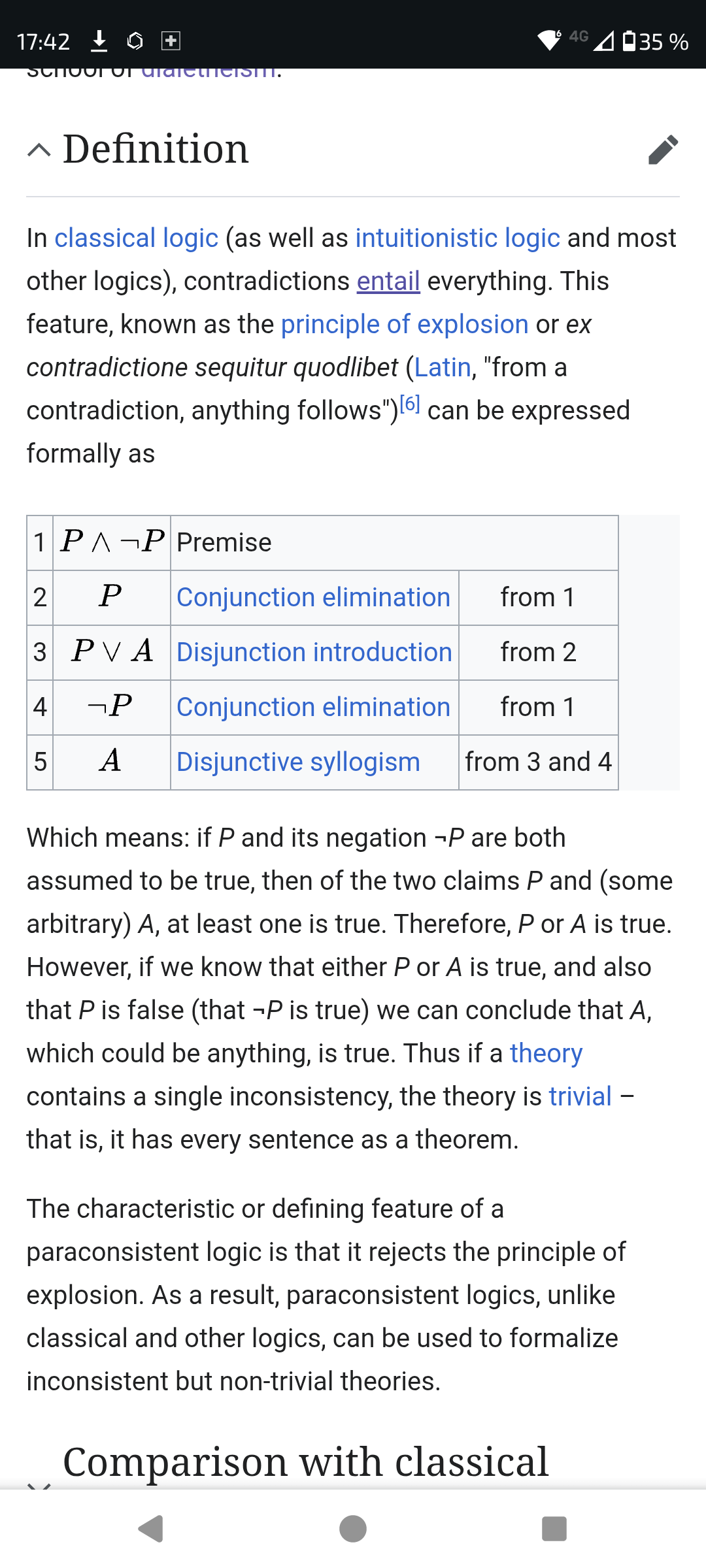
The image of the Wikipedia definition shows a general set of sentences that shows why contradictions end up with everything being true.
How does Paraconsistent Logic solve this?
I don’t yet know for sure…. However my understanding right now is that disjunctive syllogisms are not “allowed” when there is one or more inconsistencies.
Seems quite simple, so either I’ve understood it or there’s more to it!
The historical sequence
- Classical logicians (Frege, Russell, Hilbert, Gödel): Avoid contradiction at all costs
- Expert System researchers (1970s-80s): Non-monotonic logic for defeasible reasoning
- Paraconsistent logicians (da Costa, Priest): Tolerate contradiction without explosion
The Classical Logicians tried to rise above with classical logic and work was dismantled with (sometimes simple) statements, whereas paraconsistent logic rises from within, accepting contradictions, but with a smaller scope of “truth”.