Dual state domain
Rough work to be made clearer
Domain Table
| Scope | Symbol | Name | Formal Definition |
|---|---|---|---|
| State Space | |||
| Composite | S | System State | S = S_workflow × S_env (Def. 1) |
| Control | S_workflow | Workflow State | {σ | σ : G → {⊥, ⊤}} — truth assignments tracking guard satisfaction |
| Information | S_env | Environment State | 𝒜 × 𝒞 (Def. 1, Eq. 3) |
| Workflow Components | |||
| Static | G | Guard Set | {g₁, …, gₙ} — unique guard identifiers |
| Dynamic | σ | Current State | σ : G → {⊥, ⊤} — specific truth assignment |
| Function | T | Transition Function | T(s_w, ⊤) = s_w[g_id ↦ ⊤]; T(s_w, ⊥) = s_w (Def. 8) |
| Environment: Global | |||
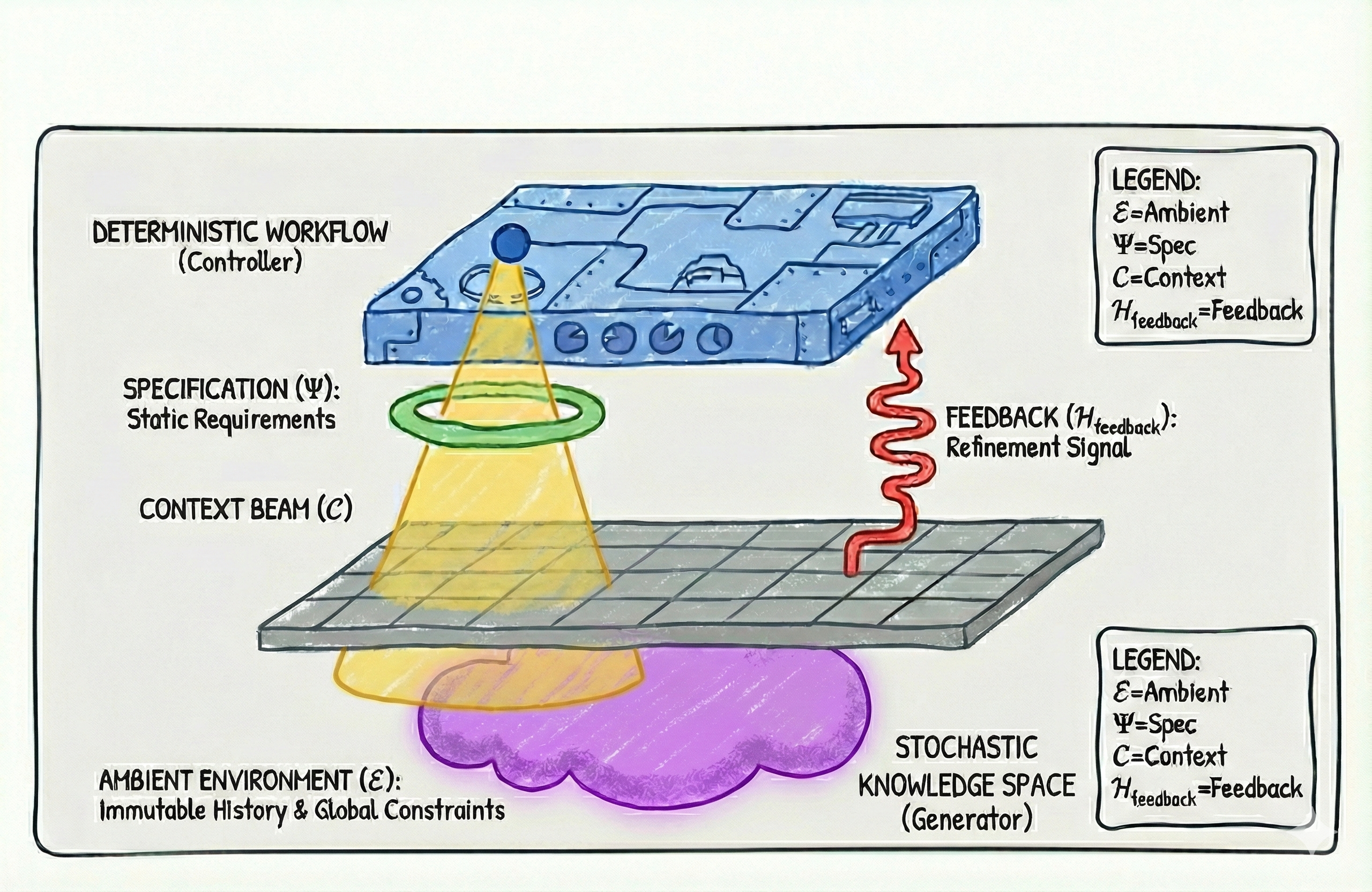
| Persistent | R | Versioned Repository | Append-only DAG: R = {(a₀…aₖ) | aᵢ ∈ 𝒜} (Def. 2) |
| Static | Ω | Global Constraints | Invariant safety rules |
| Container | E | Ambient Environment | ⟨R, Ω⟩ — read-only access to ancestors |
| Environment: Node-Local | |||
| Static | Ψ | Static Specification | Requirements/tests for this step |
| Mutable | aₖ | Candidate Artifact | Artifact under validation (output of a_gen) |
| Container | C_local | Local Context | ⟨Ψ⟩ — step specification |
| Transient | H_feedback | Feedback History | [(id_k, φₖ), …] — cleared on state advance (Remark 2) |
| Context Composition | |||
| Total | C_total | Context | ⟨E, C_local, H_feedback⟩ (Def. 3, Eq. 4) |
| Action Pair | |||
| Tuple | A | Action Pair | ⟨ρ, a_gen, G⟩ (Def. 6) |
| Function | ρ | Precondition | ρ : S_workflow → {0, 1} |
| Function | a_gen | Generator | a_gen : C → 𝒜 |
| Function | G | Guard | G : 𝒜 × C → (v, φ) |
| Config | θ | Guard Parameters | Configuration thresholds for G_θ |
| Guard Result | |||
| Status | v | Verdict | v ∈ {⊤, ⊥_retry, ⊥_fatal} |
| Output | φ | Feedback | φ ∈ Σ* — diagnostic message |
| Planning | |||
| Tuple | P | Planning Problem | ⟨S_workflow, A, s_w0, C_init, S_goal, R_max⟩ (Def. 9) |
| Bound | R_max | Retry Limit | Finite budget per node |